Looking for an easy way to add more ESL pronunciation practice to your lessons? Additionally, Tongue Twisters are one of my favorite ways to do it and fit well in diverse lessons.
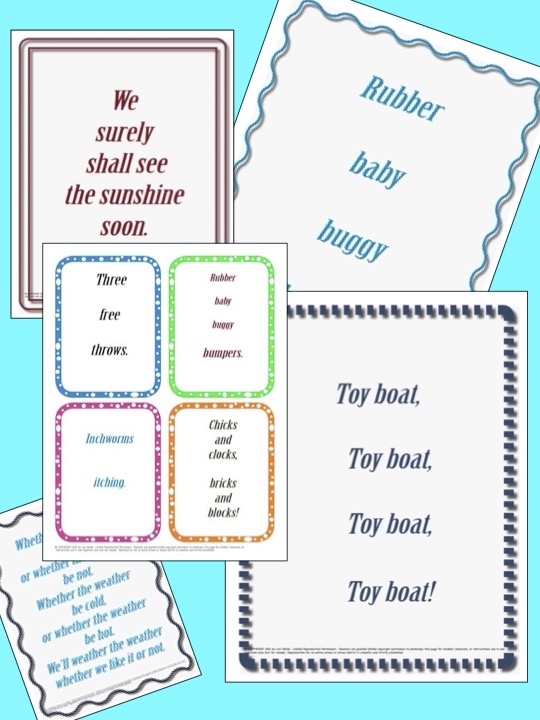
For Tongue Twisters, English learners gain repeated practice with sounds, blends, rhythm, fluency, and connected speech.
Moreover, they can be used in just a few minutes at the beginning of an ESL lesson.
They can also be used at the end of an ESL lesson.
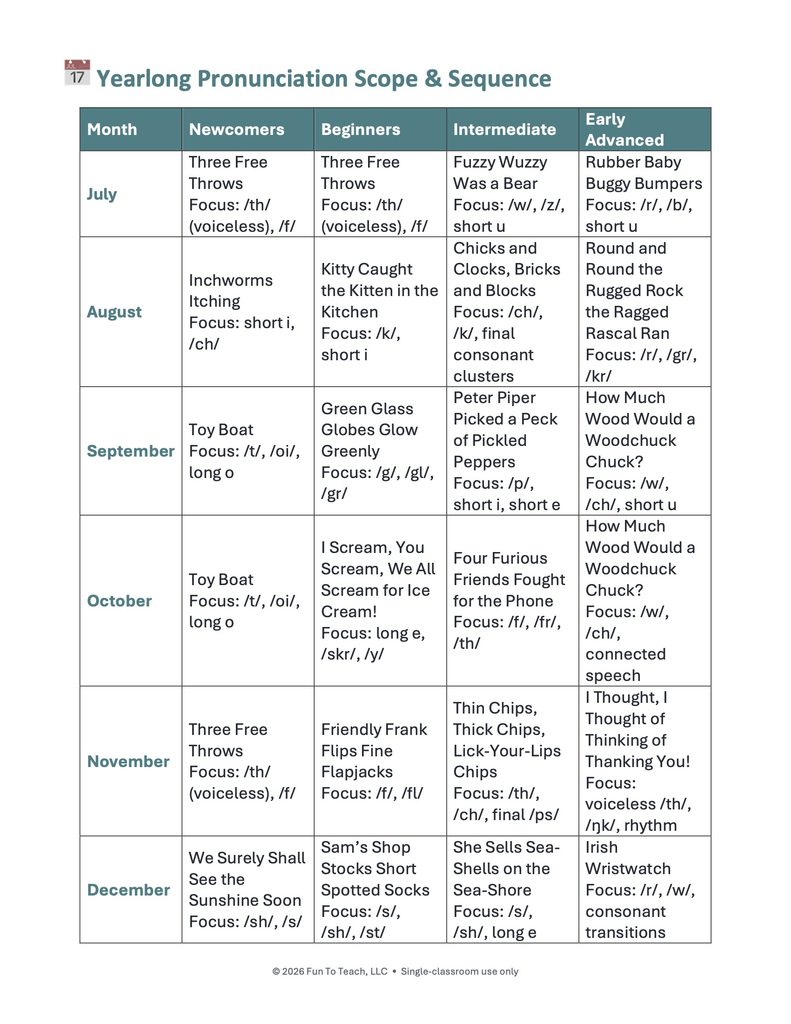
Over the past several months, I have been updating and improving my monthly ESL curriculum bundles and my ESL Yearlong Curriculum | K–5 Lesson Plans. As part of those updates, I created a Yearlong Tongue Twister Pronunciation Scope and Sequence to help teachers know which pronunciation skills to focus on throughout the school year.
The guide provides a suggested tongue twister for each month and ESL proficiency level, along with focus sounds, additional practice choices, and practical ideas for classroom use.
To make planning even easier, the Yearlong Tongue Twister Pronunciation Scope and Sequence is included in my complete Tongue Twisters Pronunciation Resource. Every tongue twister suggested in the guide comes directly from that resource, so you have the full set of practice activities ready to use throughout the year.
Why Use Tongue Twisters With English Learners?
Planning takes time, so the good news is that pronunciation practice doesn’t have to take up a lot of your lesson time.
For example, a short tongue twister can help students practice:
- individual English sounds
- beginning and ending sounds
- consonant blends
- vowel sounds
- rhythm and pacing
- connected speech
- speaking fluency
- clear pronunciation
Tongue twisters also give students a reason to repeat the same sounds several times without the practice feeling repetitive.
For English learners, that repetition can be especially helpful.
Remember, the goal isn’t to see how fast students can say the tongue twister. Instead, it’s to give students a chance to really hear the sounds, practice saying them clearly, and at the same time, build confidence speaking English along the way.
Keep ESL Pronunciation Practice Short
I like to use tongue twisters as a quick pronunciation warm-up. They’re easy to fit into a lesson and give students a fun way to practice before moving on to the rest of the day’s learning.
You might spend just 3–5 minutes practicing one tongue twister several times during the week.
Try reading it together first.
Then practice one line or phrase at a time.
Students can tap the rhythm, clap the syllables, repeat after you, practice with a partner, or try saying the tongue twister independently.
As students become more comfortable, they can work on smoother phrasing and a more natural speaking pace.
The important thing is to stop before students become frustrated or begin sacrificing clear pronunciation for speed.
October ESL Tongue Twisters Pronunciation Practice
Here is an example of how the tongue twisters pronunciation scope and sequence works for October.
🌱 Newcomers Tongue Twisters
Featured Tongue Twister:
Toy Boat
Focus Sounds:
/t/, /oi/, long o
Additional Practice:
Inchworms Itching
Three Free Throws
Suggested Use:
Use repetition and tapping to help students keep a steady rhythm. Keep practice short and stop before students begin losing accuracy.
🌿 Beginners Tongue Twisters
Featured Tongue Twister:
I Scream, You Scream, We All Scream for Ice Cream!
Focus Sounds:
long e, /skr/, /y/
Additional Practice:
Kitty Caught the Kitten in the Kitchen
Friendly Frank Flips Fine Flapjacks
Suggested Use:
Read one line at a time and encourage students to add expression. Spend extra time practicing the /skr/ blend in scream.
🌳 Intermediate English Learners Tongue Twisters
Featured Tongue Twister:
Four Furious Friends Fought for the Phone
Focus Sounds:
/f/, /fr/, /th/
Additional Practice:
Thin Chips, Thick Chips, Lick-Your-Lips Chips
Fat Frogs Flying Past Fast
Suggested Use:
Focus on the airflow students need for /f/ and help them hear and produce the difference between /f/ and /th/.
🌲 Early Advanced English Learners Tongue Twisters
Featured Tongue Twister:
How Much Wood Would a Woodchuck Chuck?
Focus Sounds:
/w/, /ch/, connected speech
Additional Practice:
Round and Round the Rugged Rock the Ragged Rascal Ran
Peter Piper Picked a Peck of Pickled Peppers
Suggested Use:
Use repeated readings to work on accuracy, fluency, and more natural phrasing.
Differentiate Pronunciation Practice by ESL Level
Just like with everything else we teach, our English learners aren’t all ready for the same kind of pronunciation practice.
Newcomers may need lots of teacher modeling, repetition, pictures, gestures, and short chunks of language.
Beginning English learners can start working with longer phrases and common consonant blends.
Intermediate students can focus more closely on sounds that are difficult to distinguish or produce.
Early Advanced students can work on connected speech, phrasing, rhythm, and fluency.
That is one reason I organized the Tongue Twister Pronunciation Scope and Sequence by proficiency level.
Instead of using the same tongue twister with every student, you have a starting point for choosing pronunciation practice that better matches your students’ language development.
A Simple Weekly Tongue Twisters Routine
You can keep tongue twister practice very simple.
Day 1: Introduce the tongue twister and model the target sound.
Day 2: Practice slowly together.
Day 3: Practice in short phrases or with partners.
Day 4: Add rhythm, expression, or repeated readings.
Day 5: Let students perform the tongue twister individually, with a partner, or as a group.
You do not have to use it every day. Even a few short practices throughout the week can give students meaningful opportunities to hear and produce English sounds.
Make Pronunciation Planning a Little Easier
I created the Yearlong Tongue Twister Pronunciation Scope and Sequence to make pronunciation planning a little easier and to take some of the guesswork out of choosing what to practice each month.
However, if you’d like the complete set of tongue twisters along with the Yearlong Pronunciation Scope and Sequence, you can find them in my Tongue Twisters Pronunciation, Alliteration & Speech Fluency Practice for ESL resource in my Fun To Teach TpT store.
It’s a nice resource to have on hand when you want a quick, ready-to-use way to add pronunciation and speaking practice to your ESL lessons.
Looking for Your ESL Lessons for the Whole Year?
If you are looking for more than pronunciation practice, my ESL Yearlong Curriculum | K–5 Lesson Plans gives you an organized plan for teaching English learners throughout the school year.
It includes monthly Implementation Guides, differentiated resources, vocabulary, grammar, language functions, pronunciation, speaking practice, and instruction for multiple English proficiency levels. Click here to learn more.
The goal is simple: help you know what to teach next without spending hours searching for resources and planning everything from scratch.
The planning is done. The teaching is yours.
I hope these tongue twisters bring a little fun—and a lot of speaking practice—to your ESL classroom!
I’d love to hear how you use pronunciation practice with your English learners. Leave me a comment below!