“Don’t put all your eggs (or Mixed-Proficiency ESL Classes) in one basket.”
This old idiom dates back hundreds of years and reminds us not to rely on just one way of doing something. If all your eggs are in one basket and you drop it…well, you know what happens!
The same idea applies when teaching a mixed-proficiency ESL class.
If you’ve ever thought you needed four different lesson plans—one for newcomers, one for beginners, one for intermediate students, and one for your more advanced learners—I’ve got some good news.
You don’t.
One of the biggest lessons I’ve learned over the years is that students don’t all have to do the exact same activity to learn the same language skill.
Start with One Language Goal for Mixed-Proficiency ESL Classes
Instead of planning separate lessons for every proficiency level, begin with one language objective.
For example:
Language Goal: Students will describe classroom objects.
Now think about how each group can work toward that same goal.
Newcomers
Point to and name classroom objects.
“Book.” “Pencil.” “Desk.”
Beginning English Learners
Use simple sentence frames.
“This is a pencil.”
Intermediate English Learners
Describe classroom objects.
“The blue notebook is on my desk.”
Early Advanced English Learners
Compare, explain, or describe in more detail.
“I use my notebook to write new vocabulary words every day.”
Everyone is learning together.
Everyone is successful.
The support simply looks different.
Use the Same Theme for Mixed-Proficiency ESL Classes
One thing that makes planning much easier is teaching everyone around the same monthly theme.
Whether you’re learning about Back to School, Communities, Weather, or Animals, every student can participate.
The vocabulary stays connected.
The conversations stay connected.
Your classroom feels like one community instead of four separate groups.
Let Supports Do the Heavy Lifting
Differentiation doesn’t always mean creating more work.
Sometimes it simply means providing different supports.
For example:
- picture cards
- sentence frames
- word banks
- visuals
- partner practice
- graphic organizers
As students become more confident, you gradually remove those supports.
That’s language growth happening naturally.
Students to Learn From One Another in Mixed-Proficiency ESL Classes
One of my favorite things about mixed-proficiency classrooms is watching students help each other.
A newcomer may learn a new word by listening to an intermediate student.
An intermediate student becomes more confident by explaining something to a classmate.
Everyone benefits from hearing English used at different levels.
Mixed Proficiency Classes Keep Everyone Talking
No matter what proficiency level your students are at, every lesson should include opportunities to use English.
Ask questions.
Practice with partners.
Play vocabulary games.
Use sentence frames.
Share ideas.
The more students hear and use English, the faster their confidence grows.
Don’t Be Afraid to Review
Here’s something I remind myself every year.
English learners need repetition.
Lots of repetition.
Revisiting vocabulary, grammar, and language structures isn’t going backward—it’s helping students build a stronger foundation.
That’s why spiral review has always been an important part of my classroom.
Remember: Progress Looks Different for Every Student
It’s easy to compare students.
Try not to.
Celebrate the newcomer who used a complete sentence for the first time.
Note the beginner who asked a question in English.
Celebrate the intermediate student who volunteered to share with the class.
Every student is making progress—even if that progress looks different.
One Lesson. Multiple Levels.
Teaching mixed-proficiency classes doesn’t have to mean planning four completely different lessons.
Start with one language goal.
Adjust the level of support.
Keep everyone engaged in the same theme.
Celebrate growth along the way.
You’ll spend less time planning and more time doing what you love—helping your students become confident English learners.
Looking for a Curriculum That Does This for You?
When I was creating lessons for my own classroom, I quickly realized I didn’t want four separate lesson plans either.
That’s one of the reasons I created my ESL Yearlong Curriculum | K–5 Lesson Plans.
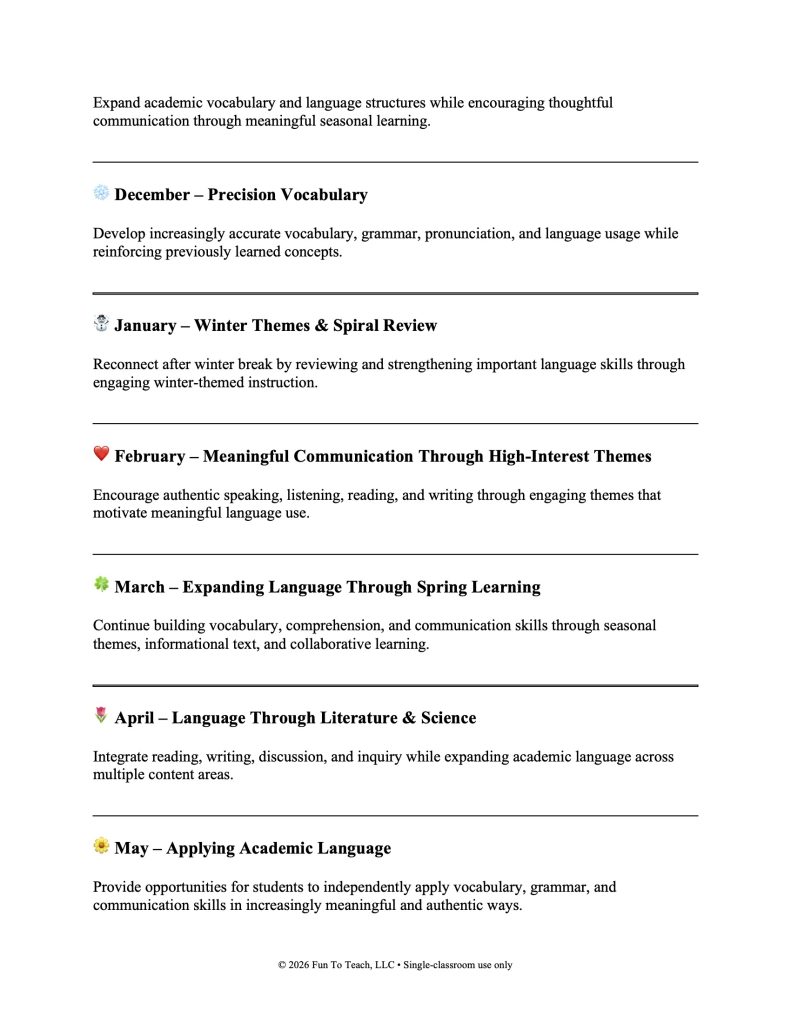
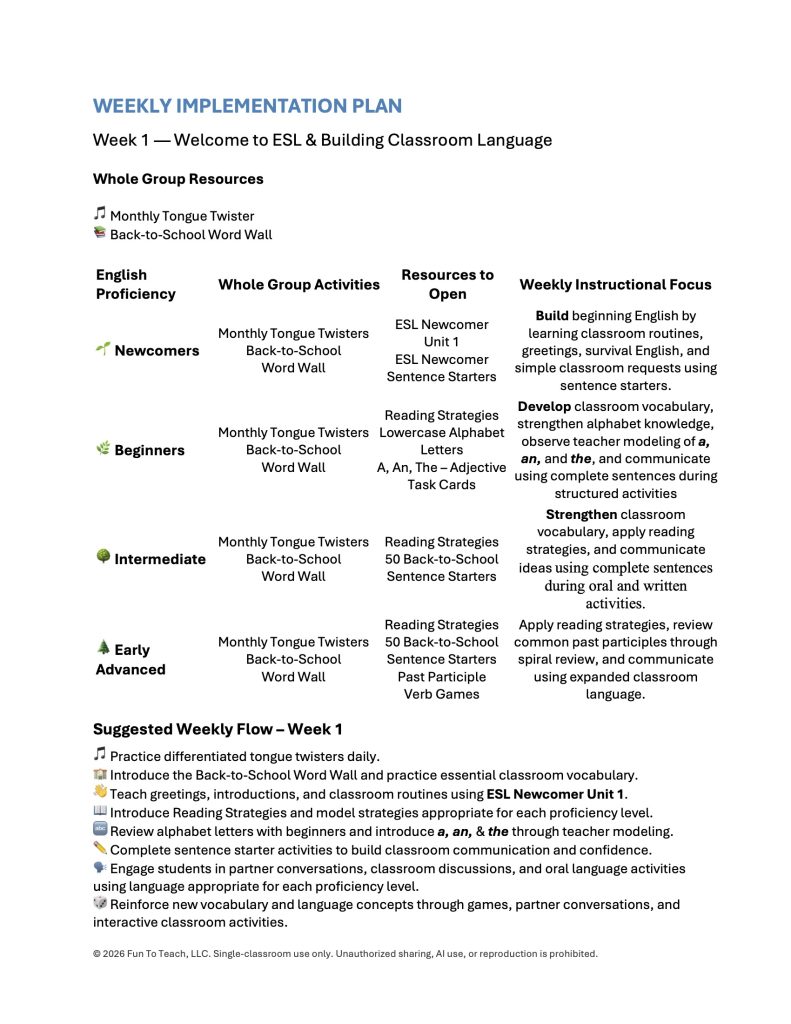
Each month is organized around a common language focus and theme, with differentiated resources for newcomers, beginners, intermediate learners, and early advanced students. Instead of creating separate lessons for every group, you’ll have one organized plan with the supports each proficiency level needs.
If you’re looking for something smaller to start with, my monthly ESL curriculum bundles follow the same approach, making it easy to teach mixed-proficiency groups while keeping everyone learning together.
Because when the planning is done, the teaching is yours.
Happy teaching!
– Lori